Spring Clean Your Home Office: A 30-Minute Checklist
A practical 30-minute seasonal reset for your home office: clear the desk, empty a drawer, archive paper,...

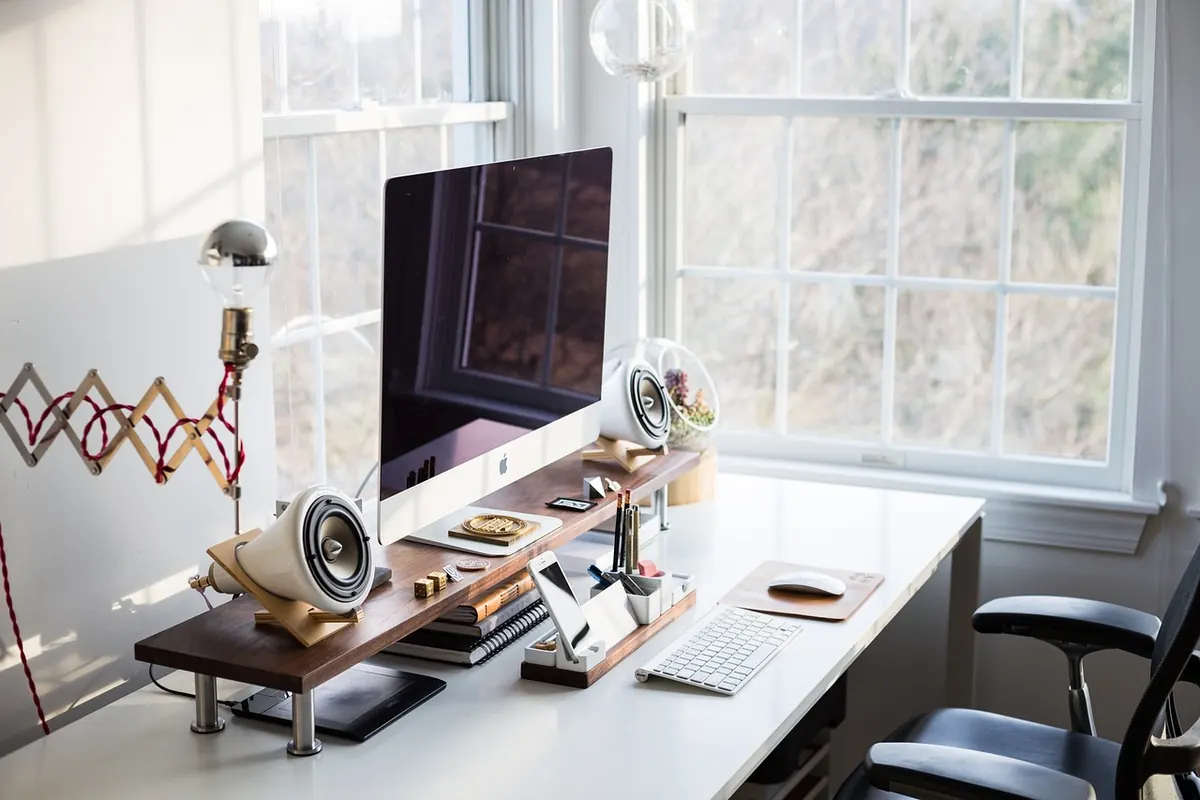
There's a particular moment in a British winter — somewhere between three and half past — when the sky turns the colour of wet cardboard and the document you've been reading for twenty minutes quietly stops making sense. The heating is on, the coffee has gone cold, and the working day still has a couple of hours left in it. Light has a lot to do with what's happening. Not in any mystical sense: your desk simply becomes dimmer and flatter, your eyes work harder, and your attention follows your eyes. The good news is that most of the fix is practical. Better bulbs, better placement, and a bit of thought about timing will get you through to March.
In December, the sun is down before four o'clock across most of the UK, and earlier than that in Scotland. By mid-afternoon the light coming through your window has lost both its intensity and its direction, so shadows soften into a general grey wash. Your screen becomes the brightest object in the room, which sounds fine until you notice what it does to your eyes: they're constantly readjusting between a glowing rectangle and a murky desk around it.
There's a second effect that matters just as much. Bright light in the morning helps anchor your body clock, and fading light in the evening signals that the day is winding down. A winter afternoon fudges both messages. You get the flat, slightly foggy feeling that people usually describe as the slump. You can't change the weather, but you can change the light on your desk — and that's the part you actually sit in.
Colour temperature is measured in kelvin (K), and it describes how warm or cool a white light looks. Counter-intuitively, the higher the number, the cooler and bluer the light. This single number will change how alert you feel at your desk more than almost anything else you can adjust.
If you buy one bulb for winter work, make it 4000K. If you work with colour — design, photography, print — look for a colour rendering index (CRI) of 90 or above, or colours on screen and paper won't match.
Ignore wattage and look at lumens. A desk lamp giving you around 400–800 lumens is right for screen work and reading; detailed paperwork or drawing benefits from more, and the lamp should be dimmable so you can take it down when the sun makes a brief appearance. Check the fitting before you buy — UK lamps usually take E27 screw or B22 bayonet caps, and small spots often use GU10, which isn't dimmable on every circuit.
Two quality details are worth the extra few pounds. First, cheap LEDs can flicker in a way you don't consciously see but your eyes still register as fatigue; buying from a known brand and choosing a lamp with proper dimming rather than a bargain strip is money well spent. Second, an adjustable arm or a shade you can angle beats a fixed uplighter every time, because you'll be repositioning it as the day changes.
Position matters more than most people expect. For a right-handed writer, the classic spot is to the left and slightly in front, so the light falls across the page without your hand casting a shadow over what you're reading. Left-handers should mirror it.
Three rules cover most situations:
A small amount of light behind the monitor — bias lighting, in effect — softens the contrast between screen and wall, and it's one of the cheapest improvements you can make to a dark corner desk.
Treat morning and afternoon as different lighting jobs. The aim in the morning is brightness and a cooler tone to get you going; the aim after four o'clock is clarity without harshness, then a gradual wind-down. A rough routine:
If you find yourself losing focus every winter in a way that affects your mood, sleep or appetite for weeks at a time, that's a conversation for your GP rather than a bulb upgrade. Lighting helps enormously with the ordinary afternoon dip; it isn't a treatment.
Swap your desk bulb for a 4000K LED, dimmable, CRI 90 if you work with colour. Move the lamp to your non-writing side, forward of your shoulder, shade angled down and below eye level. Put a low, warm light somewhere behind the monitor so the wall isn't a black hole. Set the ceiling light on a low dim during the day, and switch to 2700K after your evening meal. If your lamp has a timer or smart plug, use it — the whole point is that the light changes before you notice you've slowed down.
None of this defeats a British December. It does mean that four o'clock in the afternoon looks and feels like a working hour again, which is a reasonable thing to ask of a bulb.
Photo: StockSnap / Pixabay
A practical 30-minute seasonal reset for your home office: clear the desk, empty a drawer, archive paper,...
A practical £300 plan for a home office, covering where to spend first, how to choose a second-hand chair,...
Oversized furniture, dark corners and visual clutter all shrink a small home office. Here are the common...