Spring Clean Your Home Office: A 30-Minute Checklist
A practical 30-minute seasonal reset for your home office: clear the desk, empty a drawer, archive paper,...

Most home office purchases are easy to justify. A chair, a lamp, a better webcam — you either use them or you don't. A desk is different. It sets the height of everything else in your working day: your shoulders, your wrists, your eyeline, and how willing you are to stay there at four o'clock. It is also the piece of furniture you are least likely to replace on a whim, because it is heavy, awkward to return and usually assembled before you discover what you do not like about it. If you're buying your first proper desk, the choice usually comes down to two options: fixed height or sit-stand. Here's how they compare on the things that actually matter.
Fixed desks are sold at one working height, usually somewhere around 72–75cm. That suits plenty of people, particularly if you're close to average height and your chair adjusts properly. But if you're tall, you end up hunched, or with your chair raised until your feet dangle. If you're shorter, your chair goes up and your feet leave the floor unless you add a footrest. Neither situation is comfortable for eight hours, and neither is fixed by buying a more expensive chair.
Sit-stand desks adjust. Many electric frames cover roughly 65cm to 125cm, though it varies by model and budget frames often stop short at the top. That upper limit is the first number to check. When you stand, the desk should sit at about elbow height with your shoulders relaxed — for many people that lands between 100cm and 115cm, and taller users need more. If you are 6ft 4in and the desk tops out at 120cm, you may still be bending your wrists or lifting your shoulders to type.
So the real question isn't whether a desk moves, but whether it moves high enough for you and low enough for your chair. Measure your seated and standing elbow heights before you buy. Sit on your current chair, let your arms hang, then bend them to 90 degrees. Measure from the floor to the underside of your elbow. Do the same standing. Two minutes with a tape measure beats any product description.
When the desk rises, everything on it rises too. A monitor that sits perfectly while you're seated will be too low when you stand. A monitor arm solves it in seconds; so does a stack of books. Check the desk can take a clamp or grommet mount before you commit. If you use a laptop only, a separate riser and keyboard are worth the desk space, because a laptop screen at standing height forces your arms into an awkward angle.
A fixed desk asks for a rectangle of floor and nothing else. That makes it the easier fit in a box room, a converted alcove or under a sloped ceiling, where a rising desk might meet a shelf or a window sill halfway up. You also avoid the extra depth many sit-stand frames need at the back for the motor and legs. In a small UK spare room, that can be the difference between a desk that fits and one that blocks the door.
Sit-stand desks need clearance above and behind. Check the maximum height plus whatever is on the desk — a monitor, a lamp, a plant — against shelves, wall cabinets, blinds and loft sloped ceilings. Also check the floor. Uneven floorboards can make a two-leg desk wobble more than it would on a solid floor, and carpet can hide the small feet you need for stability. If you rent, think about whether you can drill for cable management or monitor arms; a freestanding desk with clamp-friendly edges is often the safer choice.
A fixed desk is simple. You can buy a decent 120cm–140cm top and legs for well under £150, and second-hand office desks are plentiful on UK marketplaces. There is no motor to fail, no control box, no power supply and no memory preset to lose. If your budget is tight, a fixed desk plus a good chair and a footrest is usually a better ergonomic investment than a cheap standing desk that wobbles at its highest setting.
Sit-stand desks cost more, but the range is wide. Manual crank models can start around £150–£250, while electric dual-motor frames with memory settings often run from £250 to £600 or more. The extra cost does not stop at the desk. You may want cable trays, a longer power cable, a surge-protected extension lead and a monitor arm. Electric desks also need a nearby socket, and the control box and motors take up space that fixed desks do not.
Look for a warranty of at least five years on the frame and motor, and check what it covers. Some budget desks have impressive height ranges but slow, noisy motors and no anti-collision. Others have a single motor that strains under a heavy load. If you plan to keep a dual-monitor setup, a printer or heavy books on the desk, pay attention to the lift capacity as well as the height range.
Fixed desks win on stability. A solid fixed desk does not move when you type, lean on it or stand up. That matters if you write, draw or use a mouse for fine work. Sit-stand desks can be rock solid, but cheap ones often wobble at standing height, especially front-to-back. If you have ever tried to type on a desk that sways, you know how quickly it becomes annoying.
Noise is another daily factor. Electric desks hum or whirr as they move. Some are quiet enough to adjust during a call; others are not. If you share a room, work early or take lots of video meetings, listen to reviews or try one in person. Speed matters too: a desk that takes 45 seconds to rise makes you less likely to bother. Memory presets are not a gimmick — they turn standing into a one-touch habit rather than a chore.
The biggest variable is you. A sit-stand desk only helps if you actually stand. Many people buy one, raise it for a week, then leave it at seated height forever. If you already struggle to take breaks, a fixed desk plus a timer that reminds you to walk around may deliver more benefit than a motor you ignore. If you know you respond well to small rituals, the sit-stand desk can make movement easier to build into the day.
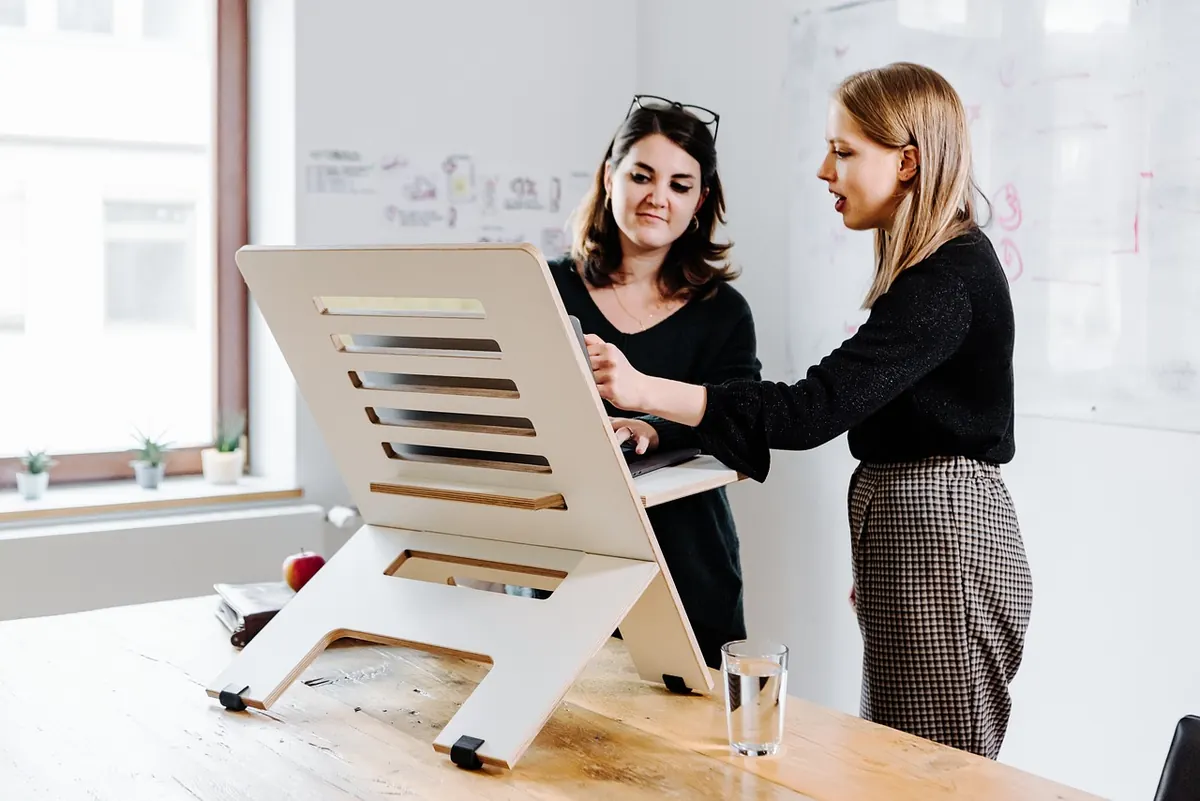
If you like your current desk, or you rent a furnished place and cannot replace it, a standing desk converter can be a smart compromise. These sit on top of a fixed desk and lift a laptop or monitor and keyboard to standing height. They cost less than a full sit-stand desk, need no assembly tools and are easy to move aside. The trade-offs are stability, keyboard space and monitor height. A converter can feel cramped with two monitors, and the lifted platform may wobble more than a proper frame.
Another middle ground is a fixed desk at the correct seated height plus a wall-mounted or clamp-on monitor arm. This does not let you stand, but it fixes the most common desk-related problem: a monitor that is too low. For many home workers, that alone removes neck and shoulder discomfort. If standing is not essential to you, spending the sit-stand budget on a better chair, a footrest and a monitor arm can be the more comfortable choice.
Before you add anything to your basket, ask these questions:
If you have the space, the budget and a genuine intention to alternate between sitting and standing, a good electric sit-stand desk is the more flexible choice. It lets you fine-tune the height for your body and your chair, and it gives you the option to stand without rearranging your whole office. But a cheap sit-stand desk is not automatically better than a solid fixed desk. If the frame wobbles, the motor is slow or the top range does not reach your standing elbow height, you have paid more for a worse experience.
A fixed desk remains a sensible, affordable and stable option — especially in small rooms, rented flats or under sloped ceilings. Match it to a proper chair, get the monitor height right and use a footrest if your feet do not reach the floor. A fixed desk that fits you properly will beat a standing desk that does not. The best desk is the one that disappears from your attention, so you can get on with the work.
Photo: Standsome / Pixabay
A practical 30-minute seasonal reset for your home office: clear the desk, empty a drawer, archive paper,...
A practical £300 plan for a home office, covering where to spend first, how to choose a second-hand chair,...
Oversized furniture, dark corners and visual clutter all shrink a small home office. Here are the common...